
Another early morning departure followed, carrying me and another group of Dutch and French tourists from Yogyakarta and Central Java to the East side and the massive volcanic outcrop around Mt. Bromo. Being the most populated island in Indonesia, you can't go far in Java without passing village after village, weaving your way in and out of the crazy traffic, dodging motorcycles, walkers and the occasional cow. Between the villages, we passed through flat rice paddies, flooded plains with rice stems growing up out of the water, with workers in the traditional triangular hats hunched over, planting and cutting the stalks, all done with back-breaking manual labor. The infrequent ox helps to plow the fields in between harvests, but judging by the number of workers in these fields along the side of the road, it looks like much of this pain-staking process is still done by hand here (as in other parts of Southeast Asia). Behind the rice paddies, a row of distant mountains cuts through the hazy horizon. Along the way, we passed through a few strands of forest, some tropical with the broad, green leaves of banana trees lining the road, though other forests seemed to be a little more deciduous, looking more like oak trees spread out across the forest with little undergrowth, leading me to wonder if this is actually a natural forest or something planted here. This area of East Java is also said to be the home of a few reclusive elephants, though I can't imagine seeing the endangered beasts anywhere near the cacophony of the road and villages along the way. After a few bathroom and snack stops, we arrived in a small office in the middle of nowhere around 8 pm, transferring to a smaller bus for those of us moving on to the volcano and another bus for those going straight to Bali. As you might expect, the promises made when booking the trip weren't exactly true, and, at this point, you really don't have an option to choose another tour, so we went along with our new guide, though the tour was actually only $1-2 more than promised, so it wasn't that bad.
Being alone, I was assigned to a small hotel just outside of Cemoro Lawang, the base for expeditions to the volcanoes. When I arrived, there was, predictably, some debate as to whether or not they actually had a room for me, so I was told to go have dinner in the restaurant while things were sorted out. Eventually, they found a spot for me in a tiny, two-story room, the first story just being a small room with six and a half foot ceilings and nothing other than a safe and a ladder leading upstairs to another cramped room with two short beds laid out on the floor. Fortunately, I wouldn't be sleeping long anyway, so this was good enough for the night, along with a warm blanket, as the temperature here in the highlands actually gets pretty cold at night. Up the next morning at 3:30, I had the 'breakfast' of a piece of toast and a tiny banana and was herded into one of the awaiting 4 x 4s, an old Toyota Land Cruiser from the 70s, actually one of my favorite old cars, so I enjoyed the ride in the jumpseats, crammed up with three more people in the back and two passengers and a driver up front in this tiny version of an SUV. We drove uphill through the darkness, creating a line of headlights with the row of vehicles all making their way to the top of the nearby mountain. Upon arriving and parking behind 100 or more similar Toyota Land Cruisers (though painted in different colors to differentiate them), we walked 15 minutes up to the view point and waited. Marvelling at the sunrise over a string of volcanoes and a misty plain below sounded idyllic, though it's not quite the same when you're on a crowded platform with a few hundred other tourists, pushing forward to the front for the perfect picture. I eventually found a spot and managed to block out the surroundings and enjoy the incredible show in front of us.
Below us, Gunung Bromo (Mt. Bromo) sat in the quiet darkness, billowing smoke into the early morning sky, flanked by a perfect volcanic cone (as opposed to Bromo which is basically a volcano missing its top thanks to a few eruptions) and backed by another volcano, all set in a huge flat plain covered in mist, with the peaks poking through, finally surrounded by a massive crater wall from an extinct super-volcano from thousands of years ago. Slowly, the sky turned from black to blue to streaks of orange along the horizon, eventually revealing the sun and the first rays of light upon the volcanoes in front of us. Watching the first light hit the active volcanoes, somewhat shrouded in mist was an incredible sight, in spite of the pushy crowd all around. Within about an hour, all but ten of us had cleared out, so this provided a much more serene environment to enjoy the views. After a few more pictures, I rushed back down the mountain to my Land Cruiser and awaiting group (though I saw two of them near me, so I knew they were just 5 minutes ahead of me), we piled back in the car and headed down the mountain. Passing through the narrow, steep road, we made our way down to the crater floor, a vast plain known now as the Sand Sea, just as the last of the morning haze was beginning to clear. We passed through the bumpy road into a field of brightly colored Land Cruisers and stopped for the second part of the volcano trip. From here, we made the easy walk up to the crater of Bromo and up the 244 steep stairs. From the parking lot to the edge of the crater was about a 20 minute, flat walk followed by a 10-15 climb up some semi-steep slopes, but there were plenty of horses to rent if I felt like being lazy, but I decided to make it feel like I was actually accomplishing something with this short walk. Once on top, you can see all the way down into the massive crater, watching the smoke billow and subside, sending a bright white cloud into the sky with each surge. A very narrow trail with steep dropoffs on both sides (one side falling into the volcano) led all the way around the crater, said to take 1-2 hours to walk around, though I was content standing at the edge of the abyss, watching the incredible natural forces at work and also questioning the wisdom of staring down into an active volcano.
Soon, I headed back down, met up again with my group and headed back to the hotel, deciding to continue on the next part of my tour, meaning another all day bus ride to Bali. Back at my hotel in Cemoro Lawang, I had to wait for a few of the crowded buses/minivans until I found a spot, crammed into the opening between the bench seat and the sliding door, though I did have a tiny stool to sit on, making it slightly more comfortable. After we got down from the mountain, we boarded a bigger bus and kept heading East. Around 5 in the afternoon, we arrived at the Eastern tip of Java and waited for the ferry to take us across the narrow straight. Though we could see Bali the whole time, this local ferry (which carried our bus and other cars) managed to take something like 3 hours with our destination tantalizingly close, though seeming fixed at the same spot on the horizon. Once we finally got to the island of Bali, we again boarded the bus, and we headed towards Denpasar, the central city of Bali, where we'd have to work out our own transportation from there, always a fun prospect, especially late at night in a completely unknown place.
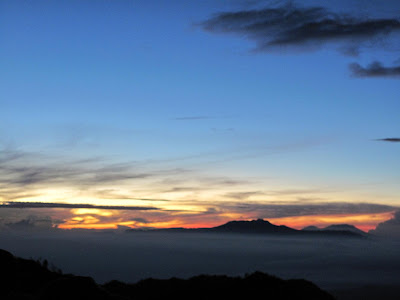 (The first signs of light coming up over the landscaped dotted with volcanic cones.)
 (Mt. Bromo is the smoking crater in the middle. As the sun came out, the mist below slowly cleared away.)
 (The first rays of morning light hitting the trio of volcanoes. Quite an impressive sight.)
 (The tourist groups with whom I shared these magical moments. Just as the sun was coming up on the mountains, I heard and felt a Chinese tourist pushing his way through people with his big camera "Oh, sunrise, perfect time for pictures." Yes, that's why we're all standing here.)
 (Slowly becoming brighter, still amazing. You can see part of the massive outer crater of the former super-volcano.)
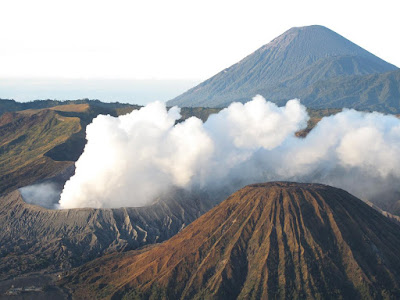 (Gunung Bromo was constantly smoking....hey, not too different from some of the local Indonesians that I've met. Heh.)
 (Most of the tourists cleared out quickly after sunrise, so I managed to find some quiet time to appreciate the volcanoes after that.)
 (A few of the hundreds of Land Cruisers that carried us up and down the mountains. I love these things.)
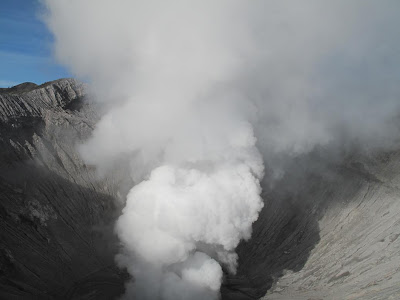 (The smoking crater from the rim, after 244 stairs, according to my guidebook.)
 (Standing along the rim, trying not to fall in or down the other side.)
Being alone, I was assigned to a small hotel just outside of Cemoro Lawang, the base for expeditions to the volcanoes. When I arrived, there was, predictably, some debate as to whether or not they actually had a room for me, so I was told to go have dinner in the restaurant while things were sorted out. Eventually, they found a spot for me in a tiny, two-story room, the first story just being a small room with six and a half foot ceilings and nothing other than a safe and a ladder leading upstairs to another cramped room with two short beds laid out on the floor. Fortunately, I wouldn't be sleeping long anyway, so this was good enough for the night, along with a warm blanket, as the temperature here in the highlands actually gets pretty cold at night. Up the next morning at 3:30, I had the 'breakfast' of a piece of toast and a tiny banana and was herded into one of the awaiting 4 x 4s, an old Toyota Land Cruiser from the 70s, actually one of my favorite old cars, so I enjoyed the ride in the jumpseats, crammed up with three more people in the back and two passengers and a driver up front in this tiny version of an SUV. We drove uphill through the darkness, creating a line of headlights with the row of vehicles all making their way to the top of the nearby mountain. Upon arriving and parking behind 100 or more similar Toyota Land Cruisers (though painted in different colors to differentiate them), we walked 15 minutes up to the view point and waited. Marvelling at the sunrise over a string of volcanoes and a misty plain below sounded idyllic, though it's not quite the same when you're on a crowded platform with a few hundred other tourists, pushing forward to the front for the perfect picture. I eventually found a spot and managed to block out the surroundings and enjoy the incredible show in front of us.
Below us, Gunung Bromo (Mt. Bromo) sat in the quiet darkness, billowing smoke into the early morning sky, flanked by a perfect volcanic cone (as opposed to Bromo which is basically a volcano missing its top thanks to a few eruptions) and backed by another volcano, all set in a huge flat plain covered in mist, with the peaks poking through, finally surrounded by a massive crater wall from an extinct super-volcano from thousands of years ago. Slowly, the sky turned from black to blue to streaks of orange along the horizon, eventually revealing the sun and the first rays of light upon the volcanoes in front of us. Watching the first light hit the active volcanoes, somewhat shrouded in mist was an incredible sight, in spite of the pushy crowd all around. Within about an hour, all but ten of us had cleared out, so this provided a much more serene environment to enjoy the views. After a few more pictures, I rushed back down the mountain to my Land Cruiser and awaiting group (though I saw two of them near me, so I knew they were just 5 minutes ahead of me), we piled back in the car and headed down the mountain. Passing through the narrow, steep road, we made our way down to the crater floor, a vast plain known now as the Sand Sea, just as the last of the morning haze was beginning to clear. We passed through the bumpy road into a field of brightly colored Land Cruisers and stopped for the second part of the volcano trip. From here, we made the easy walk up to the crater of Bromo and up the 244 steep stairs. From the parking lot to the edge of the crater was about a 20 minute, flat walk followed by a 10-15 climb up some semi-steep slopes, but there were plenty of horses to rent if I felt like being lazy, but I decided to make it feel like I was actually accomplishing something with this short walk. Once on top, you can see all the way down into the massive crater, watching the smoke billow and subside, sending a bright white cloud into the sky with each surge. A very narrow trail with steep dropoffs on both sides (one side falling into the volcano) led all the way around the crater, said to take 1-2 hours to walk around, though I was content standing at the edge of the abyss, watching the incredible natural forces at work and also questioning the wisdom of staring down into an active volcano.
Soon, I headed back down, met up again with my group and headed back to the hotel, deciding to continue on the next part of my tour, meaning another all day bus ride to Bali. Back at my hotel in Cemoro Lawang, I had to wait for a few of the crowded buses/minivans until I found a spot, crammed into the opening between the bench seat and the sliding door, though I did have a tiny stool to sit on, making it slightly more comfortable. After we got down from the mountain, we boarded a bigger bus and kept heading East. Around 5 in the afternoon, we arrived at the Eastern tip of Java and waited for the ferry to take us across the narrow straight. Though we could see Bali the whole time, this local ferry (which carried our bus and other cars) managed to take something like 3 hours with our destination tantalizingly close, though seeming fixed at the same spot on the horizon. Once we finally got to the island of Bali, we again boarded the bus, and we headed towards Denpasar, the central city of Bali, where we'd have to work out our own transportation from there, always a fun prospect, especially late at night in a completely unknown place.
 (The first signs of light coming up over the landscaped dotted with volcanic cones.)
 (Mt. Bromo is the smoking crater in the middle. As the sun came out, the mist below slowly cleared away.)
 (The first rays of morning light hitting the trio of volcanoes. Quite an impressive sight.)
 (The tourist groups with whom I shared these magical moments. Just as the sun was coming up on the mountains, I heard and felt a Chinese tourist pushing his way through people with his big camera "Oh, sunrise, perfect time for pictures." Yes, that's why we're all standing here.)
 (Slowly becoming brighter, still amazing. You can see part of the massive outer crater of the former super-volcano.)
 (Gunung Bromo was constantly smoking....hey, not too different from some of the local Indonesians that I've met. Heh.)
 (Most of the tourists cleared out quickly after sunrise, so I managed to find some quiet time to appreciate the volcanoes after that.)
 (A few of the hundreds of Land Cruisers that carried us up and down the mountains. I love these things.)
 (The smoking crater from the rim, after 244 stairs, according to my guidebook.)
 (Standing along the rim, trying not to fall in or down the other side.)


