Saturday, August 14, 2010

Up the Steep Slopes to Livingstonia

Aug 6 - 7, 2010
Making our way up, down and around some of the slightly sparsely wooded hills and mountains of the inland part of Northern Malawi, our cramped minibus headed back down towards the coast, offering nice views of the small villages lining the beaches along the Northern stretch of Lake Malawi. The next big police roadblock was actually my stop, getting off in a tiny village/crossroads called Chitimba. The town is simply a few hundred meters of shops along the main road heading North along the coast up to Tanzania, sitting at the crossroads of the dirt road leading back up to Livingstonia. The problem is that there is virtually no public transportation up the steep, windy 15 kilometer road leading from the coast (Chitimba) up to Livingstonia, perched on a sort of plateau overlooking the lake and valley below. After declining a few ridiculously expensive offers from pirate taxi drivers waiting at the junction, I met a nice young man who recommended a tiny wooden shack a few meters down for some food while I tried to make a decision. Ducking under the short wooden doorway, I walked into the tiny "restaurant" to find a dark room with one long picnic table and Rastafarian flags and articles covering the walls. Then a friendly, smiling dreadlocked man named Elijah appeared, and I was able to get a quick meal of rice, beans and beef stew while chatting with him for a while about the basics of his religious beliefs and his thoughts on the state of his country. About an hour later, I needed to make a decision, and Elijah mentioned that a few people before had left their luggage with him for a day or two, making the trek up to the top on foot. Trusting him, we took my large backpack and sleeping bag back into the back room of the restaurant behind a hanging reed wall used to separate the two rooms, revealing his bed and a few of his possessions, and I soon walked off towards the dirt road with my small backpack and just a few supplies for the night.

Knowing that the long walk would be hard and take about 3-3.5 hours, I hurried up the track, passing a few farms and tiny huts as the road began snaking upwards into the thick woodlands up the mountainside. Immediately starting off, I thought I caught a huge break, as a car came up the road, but it was packed full of German tourists, so there was absolutely no room for me to hitch a ride. At this point, it was already getting late in the afternoon, giving me just about 3 hours before sunset, so I trudged along in the hot sun, starting to sweat and hoping a ride would come along, though Elijah had told me that very few cars come up the road, particularly in the afternoon. Passing a series of spectacular views, the road winds up through 20 hairpin, switchback turns before finally flattening out (relatively) for the last few kilometers. As luck would have it, after about 45 minutes of walking hard through under the bright sun and wiping away sweat, I heard the rumbling of a large truck crunching over the dirt and rocks below, so I stopped at one of the turns and hoped for a ride. Though it appeared that it was just going to drive past, the driver stopped a little down the road, and I jumped in the back of the flatbed truck, along with about 20 locals and some bags. It was probably better than the alternative of walking, but the ride up in the back of the truck on the bumpy road was extremely painful, bouncing up and down at every bump and ridge, painfully coming back down, hitting either my arms, butt or back in the process. As my body began to ache, we finally passed the entrance to Manchewe Falls, and I happily paid my minuscule fare to the driver ($2 vs the $40 quoted by drivers at the bottom of the hill) and walked over to the waterfall. Dropping 130 meters (about 440 feet), the narrow falls appears out of the forest, dropping off the sheer escarpment into the valley below. I sat in awe of the falling water at a nice viewpoint for a while before heading back towards the top of the falls for a little exploration before the sun set.

I was told there was a tiny cave under the top tier of the waterfall (about a 30 foot drop), so I walked around until finding a tiny opening and trail down some steep rocks leading to a small cave only about 20 feet deep and 10 feet high, concealed behind the mist of the top of the waterfall. Walking behind the falls was a magical feeling, though the history of the place certainly isn't a cheery one. This was apparently one of the spots that the local people used as a hiding spot when slavers came into the area in the mid to late 1800s, hiding from their prospective captors behind the loud, scenic water falling just in front of them. It was a great spot, but I couldn't really get past the somber feeling as I imagined those cowering in this very spot a hundred years before me.

As it was getting dark, I started up the gradual incline to Livingstonia, hoping I'd make it before complete darkness set in. I passed by a few sets of smiling children, happy to say hello to me, as well as a group of middle aged men dancing to some music blaring from the tiny convenience store/concrete hut isolated along the dirt road. The walk from the falls to town took me longer than expected, so I had to use my flashlight to guide the way for the last 15 minutes, passing by a few tiny houses and possibly storefronts as I asked each of the locals I saw the way to my intended hotel. The village is quite spread out along the hilltop, so I had a hard time finding my spot, though I eventually met up with a nice young guy who was on his way home from a shift at the hospital and showed me the way to the Stone House, the only proper guesthouse in the town. This is also a historical building from 1903, serving as a house for some of the missionaries and early leaders of the country. I was able to share a small room in the historic, colonial style home with two Dutch travellers after a nice local meal of rice and nsima.

Livingstonia itself was created as a home for the missionaries in the region, perched high up on the hillside to potentially reduce the risk of malaria which had caused quite a few problems in the two previous Western settlements in Malawi. Named for the explorer David Livingstone who charted much of the region, the village has existed since the late 1800s, featuring some of the more prominent and historic buildings in the Western history of the country. In the morning, I walked around the place, finding it to just be a few long dirt roads with huge trees lining the way, interspersed with a few very basic shops, a large hospital and one of the six universities in Malawi. Nevertheless, the cooler weather and great views down to the lake below make it a very scenic place, and the laidback attitude also helped its cause. Even so, I had to get on my way, deciding that I'd just walk the 15 km back down the hill instead of trying to add to any of the huge bruises on my back and arms from bouncing around in the truck bed on the way up. The walk down was much more pleasant, allowing me to enjoy the views and talk with a few of the local children who were always anxious to pose for pictures. Three hours later, I was back at the crossroads of Chitimba, hoping that I'd find Elijah and my bags happily waiting for me. Just as I expected, I walked in the tiny restaurant and found him and a few friends chatting. I spent another hour with him talking about politics and religion, also finding an article from the Malawian newspaper on this wall about Rastafarianism, echoing what he had told me before, nearly word for word. (This was also helpful because I didn't understand every word of his English.)

As there is a roadblock in both directions, I simply waited with Elijah and his younger brother, Frank, until a bus came by, and I paid my small fare and hopped on, finding it to be the most uncrowded bus I had seen in the country, meaning that almost every seat was full, but no one was standing in the aisles, so I had a relatively comfortable ride back down the coast for the next few hours, chatting with a few young schoolchildren interested to talk to an American. Eventually the bus came to a stop, and the driver instructed me that it was my turn to get off, pointing me in the direction of the next town. Within a minute, I found a shared taxi (just a small Toyota) with a few people piled in, and we made our way to the small town of Rumphi, serving as the center of the region. Rumphi is situated between a few nice, small mountains, and the flora here started to change with a bit more rock outcrops and boulders dotting the hills, along with the dry trees and shrubs along the way. Though fairly scenic, the town itself is sort of a hectic one-road place with bike taxi, trucks and minibuses all vying for your business. I found a cheap, characterless concrete block hotel room for the night, and then the next morning was spent negotiating with a few of the local drivers, finally finding a shared truck to take me down the dusty road to Vwaza Marsh. Normally transport wouldn't be a huge problem, but it was Sunday, so very few trucks were heading off in that direction, meaning that I had to wait about three hours before catching my ride, thankful that I had a seat in the cab instead of having to bounce around in the back again.


(In the upper tier of the huge Mangwere Falls, there was a scenic cave where you could walk behind the water. As pretty as it was, I felt a strange aura there, as this spot was used by locals to hide from slave traders coming in town to steal away captives about 150 years ago.)


(The 350 foot waterfall slides down the escarpment of the rift valley that runs a few miles back from the lake shore in this scenic area.)

(The historic clock tower of Livingstonia, a city built as a mission named for David Livingstone who explored much of the region in the 1860s.)

(The mission was originally in two other sites, though it moved to a higher elevation and slightly cooler climate after problems with malaria in the first two sites. Much of this city was built in the late 1800s and early 1900s.)

(Livingstonia is just a collection of a few historic buildings and local shops strewn along a dirt road or two atop the plateau.)

(A local businessman operating the sewing machine outside his tiny concrete shop, very typical of the shops I saw all throughout the country.)

(Walking back down the 15 km, 3 hour walk to the lake shore, I found the local kids loved posing for pictures.)

(These cute kids also asked for a picture to be taken, anxious to see themselves as I showed them my results on my camera.)

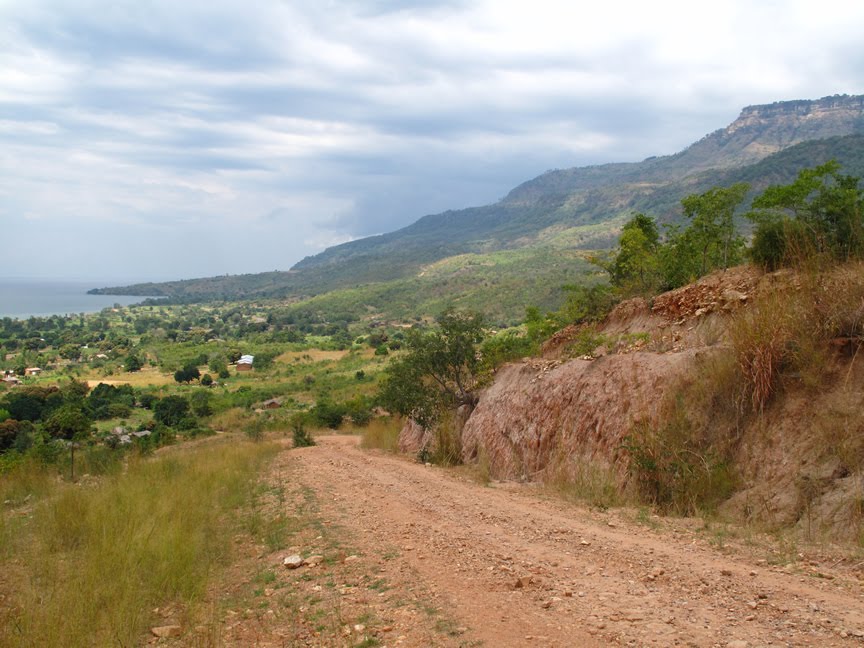
(The 15 km road is rocky and steep, featuring 21 bends, most of which are sharp, hairpin turns, winding its way from the high mountain above to the lake shore below. Fortunately, I caught a ride about halfway up. Unfortunately, it was another truck, and my back was badly bruised after that ride.)

(Frank, me and Elijah. Elijah is an amazing Rastafarian who told me all about his religion, made some great beans and rice in his restaurant and also stored my bags for me for a day while I went up to Livingstonia. Frank, his brother, is also a nice guy and loves posing for pictures.)

Thursday, August 12, 2010

Nkhata Bay - Love It or Hate It

Aug 5 - 6, 2010
Nhkata Bay is one of those places that travellers seem to rave about, touting it as one of the highlights of the area and a great spot to chill out and relax. Conversely, this often means that the place is a little overcrowded with backpackers and bars, all trying to partake of the "relaxed vibe," and this sort of stereotypical hangout was what I was hoping not to find in Nhkata Bay. As I got into town, I found a decent spot at a hostel situated at the end of the first of two lush peninsulas that jut out into the lake, forming a small bay in between. My tiny wooden bungalow sat just a few feet from a few large rocks and the lake below, providing a nice comfortable little retreat. I was also excited to see that, being a sort of Westernized (though not "touristy") area, my hostel was having fajita night, so I might get a tiny semblance of Mexican food, something that I always miss while on the road.

After dropping off my bags, I walked down the hill into town, which is essentially just the piece where the main road runs down past the bay, along with just a few blocks consisting of local houses, a few restaurants, a couple of lodging options and more local shops selling various fruits, breads, fish, supplies and second-hand clothing. Lining the streets were the omnipresent minibus drivers, all trying to guess where you were going and get you to get into their van first, as they don't leave until the vans are packed full of passengers, maximizing their tiny profits. As with most small towns in Malawi, the look (at least during dry season) is a fairly dusty, just slightly chaotic main road surrounded by the shops and many residents out wandering the streets and patronizing the shops. Though this town is adored for the fact that locals and travellers seem to mingle as one, not feeling separated from each other, I didn't particularly get any great vibe from my first few hours around the place, feeling that it was a little too hectic for my idea of a relaxing place to spend some time. I also felt like the people there, though friendly, were a little too quick to try to befriend the mazungu (the local word for foreigners/particularly white people) and then perhaps ask for shirts for their football team or supplies for their school. The main beach in the center of town was mostly obscured by little shops built along the road, as well as possessing a few garbage piles on either end, so I can't imagine wanting to really hang out in that area. Surely down the road on either side would be some nice, relaxing areas, but I didn't get the urge to stay in this area for too long.

Later in the afternoon, I went up a block or two and found the local soccer field, a long dusty stretch filled with the local children. About four separate games featuring children of similar ages grouped and playing together were taking place at the same time, getting their time on the field before the young men and adults took the field for their evening match. I had a great time just watching the children laugh and play for quite a while before I headed back around dusk, excited about the prospect of fajita night back at the hostel. Sadly, when I got back, I was informed that there was literally no chicken left in the entire town, meaning that our fajita night wouldn't be happening, so I had to settle for a basic burger to tide me over for the night. Back in my bungalow, as I was setting up the attached mosquito net around my bed, I noticed a nice large wasp nest just above the net, with two huge wasps tending to it. Unfortunately, there was no way to kill them, so I made a pact of peace with the two of them, promising not to squash them if they didn't bother me, and also hoping that my mosquito net didn't have any holes to allow them through.

In the morning, I packed my bags and headed the few minutes back into the central part of town, assessing my options for onward transport. Though it's faster to jump into the most filled minivan, as that will be leaving first, I tend to opt for the more empty ones if I'm going to a popular destination, allowing me to jump in the front seat for more legroom and less baggage and possibilities of people hanging over me, as it's not often that they try to stuff way too many people in the front. As usual, the drivers argued and fought over who should get the next passengers, but soon enough our bus filled up, and we were on the slow ride up Mzuzu, a hub in Northern Malawi. Within minutes, we were already stopping for new passengers, letting off others at every other hut along the roadside and picking up bags of tomatoes, rice or onions along the side of the road to be passed on to some future destination. Fortunately, I discovered a tasty little bread roll that is essentially just slightly fried sweet bread sold by many little children at any place a bus or van would conceivably stop. On the buses, the children and others hold their goods high, offering all sorts of drinks (Coke, Sprite, Fanta, juices - though you pay more if you don't have an empty glass bottle to be exchanged for the deposit back at the bottling facilities) and food, ranging from bananas and oranges to breads, roasted corn on the cob and not-so-fresh samosas (fried Indian turnovers with some sort of meat mix inside). People hang out the windows calling for what they want, often getting the product and then having to toss a few small bills out the window to the seller as the bus begins to drive off. On the van, things are much easier, as the lower height allows you to get a good look at the goods, providing me with a nice starchy breakfast for a ridiculously cheap price the rolls are about 7 cents each.

Heading into Mzuzu, the ride was mostly uneventful, though I found the city to be a relatively busy place, particularly in the crowded, hectic bus station in the center of town. As I got off my minibus, I was assailed with offers and requests to my next stop. This bus station proved to be particularly crazy, with drivers grabbing bags out of the back of other vans and putting it into theirs, along with pushing, shoving, yelling and locking doors and windows of other cars, preventing the poor passengers from getting into the van of their choice. As my driver yelled and pushed another driver, a few locals stepped in to hold the two angry men back as a fight was just seconds away. Inching our way out, we jockeyed for position among the buses and minivans, finally leaving the crazy bus station behind. The next drive was another interesting one, heading up into slightly more dense vegetation for a while as we stayed inland, away from the iconic lake that runs the length of the country. At one point, we encountered a scenic bridge crossing that proved to be a little tricky, since the bridge wasn't usable at the moment, with crews working to put the wooden planks back across the steel beams below that make up the one lane bridge. Traffic was stopped from both sides, so we piled out of our jam-packed van, where I was stuck in a corner seat with half a television on my legs and a teenage boy facing me, sitting between my legs, crunched up against the wall. It was a nice break to stretch my aching legs, but it was hard to tell how long we'd be at this tiny outpost. About an hour later, the worker's truck finally backed up to allow people to pass through the mostly finished bridge, though another melee ensued as each of the drivers urged their passengers back in and fought for position to be the first across the bridge. A few minutes were wasted as drivers backed up and inched forward, yelling and pointing to fight for their right to be next in line. As ridiculous as this all was, even worse was the fact that when the bridge opened up, drivers from each side of the one lane bridges surged forward, predictably coming to a stalemate at the middle of the very short bridge and standing off for another 10 minutes of arguing before our side finally all had to back up and allow the oncoming traffic to pass. This again altered our spot in line, leading to more childish arguments, though we were finally on our way again, winding up the small mountains along the escarpment formed by the Great Rift Valley of Africa. Coming back down to the coast, we had some incredible sweeping views of the vast lake and surrounding hillsides, dotted with a few villages here and there.


(I had a small thatched hut perched on the water in Nkhata Bay. Though it was nice, I did find a nice little wasp next in the top of my hut just before going to bed, though the mosquito net did its job to protect me during the night.)

(Looking from our lodge on the edge of town into the main beach, flanked by a nice green hill and vegetation, though I wasn't as impressed with town when I walked there.)

(The hectic main road was full of honking minibuses and vendors selling fruit, fish and any sort of random clothing.)

(Though it's just a small place, Nkhata Bay's one main dusty road seemed a little loud and crazy to me, given that I was expecting a laid-back backpacker's sort of town.)

(Strolling down one of the backroads, I found a few local kids playing soccer in the dirt field while the older kids dominated the goals until being kicked off by the older guys playing their evening match.)

(There may be a better beach somewhere around one of the peninsulas, but the beach in central Nkhata Bay is certainly not a place that I'd want to swim with the backs of a few shops and some trash piles lining the way.)

Chintheche - Hidden Gem of Lake Malawi

Aug 4 - 5, 2010
Moving on to Chintheche from Cape Maclear, I had a perfect storm of bus connections, allowing me to travel a relatively long way (using public transport), but it wasn't all rosy. As perfect as those connections were, the bus rides themselves were less than ideal. Granted they did allow me to get further than I expected that day, it wasn't pleasant. The seats in the bus are already cramped, and the luggage is generally just piled up as high as it can go in the first seat or two. In addition to that, other boxes are crammed into any available spot of legroom, along with a sardined row of people lining the aisle, pushing further and further into each other as the bus continued to stop for almost everyone along the side of the road. Every time you'd feel that the bus was completely full, and then you'd see that you can always add one more. Even better, some of the passengers carried live chickens in their luggage, usually a box or plastic bag with a small opening for the chicken's head, staring at the other passengers. At one point, I thought a child was screaming, but it turned out to be one of the chicken's squawking at every passing passenger. I had the joy of standing for this five hour bus segment, being pushed and pulled every time we had to reposition. As if that weren't enough, I also looked over just in time to see the woman in the seat two away from me vomiting all over herself, and it was not just a little bit. After finally depositing her entire lunch on her own dress and the bus floor, she promptly took a piece of clothing out of her suitcase and wiped the vomit from her arms and went on as if nothing had happened. A few more roadblocks and snack stops, and we finally made it up to my next stop, Chintheche. In addition to being excited about the place, I was also just ready to be done with my long, arduous day of bus travel in Malawi (which, by the way, is supposed to be one of the easier places in this part of Africa to travel).

No more than a small spot on most tourist maps, the actual town of Chintheche is basically just a barely paved semi-circle splitting off from the main road, lined with the common dusty walkways, ruts and small shops and markets along the potholed road running for just about a mile. I stopped in for a quick meal at one of the small eateries, trying nsima, one of the local staple foods. The ubiquitous meal is made from some maize flour and water, mixed together into a sort of gooey paste and then steamed to come out sort of like a undercooked tamale in consistency. Though it's not bad, it's also not high on taste, so I was thankful to find some nice chili sauce on the table. Grabbing my bags, I headed back to the main road and just a few minutes down to find a small dirt road leading to the beach and my potential lodge for the night. I passed a few smiling children and simple homesteads before reaching my lodge which turned out to be a really nice place set on a grassy plain overlooking a beautiful beach and Lake Malawi. I ended up getting a whole two bedroom hut and attached bathroom to myself, though I immediately dropped my stuff and headed through the few tall trees to the white sand. Unlike Cape Maclear, the beach here was soft and white, and with the combination of decent sized waves, it truly did look like a scenic spot on any ocean, forgetting that Mozambique would eventually be on the other shore, though out of sight in this widest point of the lake. Besides just having a wonderful beach befitting of almost tropical status, the place was free of tourists. As I wandered along the wide stretch of beach, I passed a few wooden dugout canoes used for fishing, walked through some tall grass leading to another larger beach and came upon just a few locals enjoying the late afternoon sun and hanging a few clothes out to dry. Further still, I came upon the next beach, full of the wooden canoes and fishermen packing up their nets for their evening ventures onto the lake. Thoroughly enjoying the beauty and solitude, I eventually watched the sky grow dark and made my way back to my lodge, excited that I had opted to stop at this somewhat-less visited spot along the lakeside.

Though this Northern part of the lake is less visited, about 40 km South of here is Kande Beach. I'm sure the scenery there would be nice, but after reading how it has become an incredibly popular stop for the overland trucks traveling from Kenya down to Victoria Falls and/or South Africa, I opted to stay away from that spot. As it turns out, there was a huge trance/rave party around the time I was in the area, featuring all night drinking, smoking and pumping music fueling hippies and backpackers alike, so I was glad that I opted for my quiet little gem instead of party central.

In the morning, I simply wandered back out to the beach and chatted with a few young teenagers who gave me a tour of the area and showed me how the fishermen do their work and sell their catch in their makeshift village of reed huts just behind the beach. Again, the Malawians seemed to be very friendly and outgoing, anxious to display their culture and lifestyle to anyone interested enough to make a trip to this area. Soon enough, I had to take one last look at the vast, bright white beach and fishing boats and make my way back up the dirt road into town, ready for my next stop. Though I would have enjoyed staying another day and relaxing, I wanted to continue up the coast, knowing that I didn't have all that much time to see other parts of Malawi. Back in the tiny village, I quickly found a willing minibus driver, taking advantage of the fact that the first person in a minibus gets their pick of seats, so I popped in the front with the driver and waited a few minutes for the rows in the back to fill up and then we were off to Nkhata Bay, only about 40 km North up the coastal road. As is usually the case with these minibuses, a small vehicle is packed full of people, stopping at every corner or hut along the way to pick up another passenger or perhaps drop off some supplies given to them by a friend from a neighboring area. It's fairly typical for the vans to be stripped down to just the metal and a few worn seats in the back, darkened with remnants of random food and packages carried in the strenuous lifetime of the vehicle, often held together with a sliding door that doesn't quite stay on and front doors that can only be opened from the outside thanks to broken inside handles (you can put your arm out the window and open it for yourself). The drivers also like to save gas, so it's common for them to put the car in neutral or even switch it off on a downhill stretch. On this stretch of road, we even ran out of gas at one point, where the driver instructed me to get up, so he could pop up the seat and get to the engine. Once exposed, he casually popped off one of the fuel lines, poured some more gasoline in the tank in the back and then siphoned the gas up the fuel line, spitting some of it back into the engine to give it enough to get started again, wiping his mouth afterwards as if nothing had happened. Then, he just got the van rolling and popped the clutch to get it started, as many of the starters or batteries on these vehicles no longer work, so being able to just start a car this way is much easier.

Luckily, this minibus adventure only lasted an hour or so, passing through the typical light green and brown trees of the country, growing more and more dense as I moved North. The rolling hills grew slightly larger and more lush, even giving way to large groves of huge rubber trees for a little while, though these were obviously planted in nice, neat rows for the local rubber company to cultivate. After another quick roadblock, we headed to the small bay surrounded by two large, fully wooded peninsulas and a small beach in between, revealing the tourist mecca of Nkhata Bay, another spot popular among overland tours or those heading North towards Tanzania.


(A painful moment in the five hours of standing crammed in the aisles of the crowded bus, along with boxes, chickens, and even a vomiting passenger.)

(At one of the roadblocks, people pushing to get back into their spot on the bus, packing an unbelievable amount of people and cargo into the vehicle.)


(Once in Chintheche, I had a typical meal of beef stew on the left, some sort of greens and nsima. Nsima, a staple in this region of Africa, is basically a rather bland plop of corn meal and flour, though calling it corn meal may be a little generous, as that implies a bit of taste. Actually, it's not that bad, but it certainly won't blow you away with bursting flavor.)

(My two bedroom lodge in Chintheche was quite nice, especially given the views in front of it.)

(Moving down the empty beach, I enjoyed the beautiful white sand and fairly large waves, offering the true impression of an ocean.)

(Near the end of the second beach, I found a bunch of fishermen getting ready to go out for the evening.)

(This scenic view was the view stepping out of my lodge, heading down to the quiet, beautiful beach.)

(The wide, white sands were almost completely deserted, and I was certainly the only tourist in the area.)

(More of the heavy wooden dugouts that the local fishermen use to cruise over the choppy water. This is one of the widest parts of the lake, offering no chance to see across the lake to the Mozambican mainland.)

(With the combination of beauty and seclusion, I really had a great time at the picturesque beach of Chintheche.)

Cape Maclear, Chembe and Lake Malawi National Park

Aug 2 - 3, 2010
Leaving Liwonde National Park, it seemed like a smart idea to hitch a ride with a group of young British students who were heading to the same destination - Cape Maclear. It turns out that my logic wasn't quite right. Though it did save time and another painful bicycle taxi, with 21 of us packed in the back of a flatbed truck, along with tons of heavy backpacks, there was very little room for all of us, bouncing up and down in the truck over a few dirt road and some unseen speed bumps along the main paved road. Even beginning the trip, our driver had to make a long stop at the local police office to obtain a permit to carry tourists, so he'd be able to make it through the fairly frequent roadblocks along Malawi's main roads. In spite of the uncomfortable, painful ride, I did enjoy passing through some smaller roadside villages, just a few huts and a store or two lining the main road, with the young children often running out to the side of the road to wave and say hello to the passing tourists. Given Malawi's self-proclamation of being the "Warm Heart of Africa," I expected a lot from the people, and most that I did meet were truly friendly, though not a whole lot more than I'd expect from most countries.

As we arrived in Lake Malawi National Park, a few hills studded with huge boulders began to emerge, signaling the change in landscape as we neared the Southern coast of Africa's third largest lake and the world's third deepest lake. Given the vast size and isolation, many unique fish species have evolved in the lake, and with it's amazing size, it mostly just seems like an ocean, as you can't see the other side. Unfortunately, the last 20 km into the park are along another painful dirt road, bouncing us back and forth, hoping the next bend would be the last. We finally arrived in Cape Maclear (aka Chembe) which is just a smallish village along the shores of the lake, featuring a variety of thatched and cement huts and shacks for the locals along with a few small compounds with small hotels for the tourists passing through. The British group opted for a huge, nice compound that was walled off from outsiders, offering a nice beach and restaurant, though it seemed a little too isolated from the village to me, so I walked along the dusty, sandy road to another small hotel with a few huts right along the water. Most of the area here has a nice golden sand beach, though not the finest sand I've ever seen. The views along the shore are improved by a few mountains in the background, evidence of the Great Rift Valley of Africa where two continental plates are pulling apart, leaving a huge valley (and the reservoir for the lake) in its wake. The views from the shore also feature a few nice islands just a few minutes offshore, covered in dry vegetation and lined with a few huge boulders along the edges which are mostly beachless.

Cape Maclear is one of the top tourist destinations in this small country, and it is a scenic place, though I didn't plan on spending too long there. Along the beach are fairly frequent beach touts trying to sell keychains or paintings, though the resorts have their areas clearly demarcated, and the touts obviously can't enter into the area any more than just a few yards from the water, so you can easily avoid the sales pitch if you prefer. The interesting thing about this village is that just next door to the five or ten hotel complexes, locals still go about their daily lives fishing in the mornings and evenings, splashing in the water and even washing clothes in the clear lake. The bad news about that is that a disease called schistosomiasis/bilharzia is common here, basically a little parasitic bacteria that is common in the water that gets into your kidneys and breeds for life, damaging some of your internal organs in the process. Not wanting to deal with the low risk of this, I tried to avoid the water when possible, especially in the late afternoons when it is said to be more risky.

For my first night, I had just taken a quick stroll along the main avenue of the village, waving and saying hello to the little kids along the way. As I got back, there was not really anything to do after watching a scenic sunset, even less so when the power went out. Nevertheless, I pulled up one of the lounge chairs and stared up in the peaceful night sky, watching the thousands of stars come out and light up the clear sky. Watching the shooting stars and trying to put together the constellations, I spent a few relaxing hours staring up at the sky, thinking about anything and everything, a bit disappointed when the power finally did come back on, obscuring the view a bit and pumping in some music to break up my peaceful moment.

On my second day in the village, I walked to the end of town to go inside the national park, heading over to Otter's Point, a scenic spot of beaches and boulders partially submerged in the greenish water, offering great snorkelling and good views of another offshore island and a rugged coastline. There were even a few more vervet monkeys crossing my path along the water's edge as I made my way in the pleasant, sunny day of the dry Malawian winter. Next, I rented a kayak and paddled my way around the closest offshore island, taking in the views of the fish below and the beautiful water above, offering great views back to the picturesque village setting. After about three hours of on and off paddling, I had made my way around the island and back over to Otter's Point for another view of the scenic area, catching some nice current on the way in before plopping down on a shaded lounge chair to just take in the mix of tourists and locals along the edge of the water. In the evening, I met up with two local brothers who first tried to sell me on some of their souvenirs and then just began to talk as we watched the sun set over the islands, one of the few places on Lake Malawi where the beaches face West, offering good views of the sun going down over the water. Though I enjoyed my time there, I didn't want to stay much longer, so I decided to catch the early morning transport out of there, which was an adventure in itself.

There is essentially one driver that carries people back and forth over the 20 km dirt road leading back to Monkey Bay and the paved road, beginning early in the morning and continuing a few times throughout the day. Trying to catch the first one of the day, I walked out of my hostel at 5:30 am, just in time to hear the incessant honking of the flatbed truck coming down the road. In an effort to pick up all available/interested passengers, the truck driver simply runs up and down the one main road about six or eight times, honking his horn a few hundred times in the process, leaving no doubt to anyone in town of his intentions. Once the truck is adequately full (which is much fuller than you would hope), he finally headed down the bouncy, painful dirt road, sending the passengers, backpacks, boxes of fish, thatched mats and anything else up and down around every bump and bend. By the end of the ride, my back, arms and butt were all quite sore from the bouncing up and down, grateful to finally be at the end of the road. Fortunately, just as I got off the truck, I saw the main bus coming down the road, so I was literally able to just cross the road and flag down the bus, making the perfect connection, as I would have had to wait another hour or two if I missed that one. Connecting a few hours later through Salima, I again had an amazing connection, literally walking off my bus in the station and onto the one in front of us, leaving less than ten minutes later. Though, I'd find out that my day of travel wouldn't be all that comfortable.


(Looking excited about my five or six hour ride in the back of a bumpy flatbed truck. While I enjoyed waving to the local kids along the way, I didn't enjoy the lack of any room and constant bumps.)

(The scenic golden sands of Cape Maclear make it a popular tourist stop in Malawi.)

(One of the draws of Cape Maclear/Chembe village is that it is still a traditional town, not solely based on tourism.)

(The main dirt/sand road, with the huge baobab tree marking the spot of my hotel along the waterfront.)

(A nice sunset with some locals paddling by and one of the two large offshore islands. Lake Malawi is so large that it looks like an ocean in many spots.)

(Inside Lake Malawi National Park, moments after passing by a monkey strolling on the beach.)

(Clear water and huge boulders feature in many tourist brochures for the country, shown here at Otter's Point.)

(Despite being "popular" among tourists, I had the whole place to myself for an hour or two to enjoy the serene beauty.)

(Later that day, I took to the water to experience the lake atop a kayak.)

(At this point, I was wrapping up my three hour paddle around the island and over to Otter Point, catching a nice current back down the coast.)

(Not far over the hills in the background is the border with Mozambique, as the country of Malawi more or less just borders the long, skinny lake.)

(In spite of the tourist industry, many locals still go about their daily lives, washing clothes and playing in the water just a short distance away from the few beaches blocked off by the hotels.)

Liwonde National Park, Malawi

July 31 - Aug 1, 2010
Getting up early in the morning, I made my way to the hectic bus station, walking past locals carrying all sorts of bags and produce and finding my way onto a crowded bus with the front seat piled to the ceiling with bags, buckets and even a children's bicycle. Fortunately, I was able to get a seat to myself, so the ride wasn't as bad as it could have been. We made our way out of Blantyre and soon reached the sister town of Limbe, finding another bus station amidst a bit of a shantytown with tiny mud or cement walled huts adjacent to each other, with just narrow alleys between and tin or thatched roofs above. As you might picture, there were various trash piles at the ends of the small enclave, some having been burnt, some just waiting to be. The crowded parking lot/bus station was soon engulfed in vendors tapping on bus windows trying to sell soft drinks, water, bread, bananas, belts, small toys and a few other things. Moving out of town, we got into a more deserted stretch, mostly lined with some dry vegetation and trees, topped by the occasional rock outcrop that is typical of this area, standing high on the horizon in most directions. We stopped at a few of the common roadblocks, with police surveying the scene and letting us pass. Lulling in and out of sleep thanks to the rhythmic motion of the bouncing bus and the cacophony of noise in terms of the creaking of the vehicle and the talking, singing and shouting of the passengers around me all melding into a sort of white noise around me, I was soon enough at Liwonde town.

From the tiny town center (mostly just a crossroads), I would have to find my own transport to the national park. Fortunately, this wasn't hard to find, as I was assailed with local teenage boys as I got off the bus, all yelling and shouting that they'd take me on bike taxi to the park (apparently the only reason why foreigners come to the town). Knowing this was my only option, I bargained my price and was soon on the back of a small bicycle, hanging on to a wrought iron bar constructed on the back of the boy's seat, along with a padded seat attached to the back fender. It was a nice setup, but with my heavy backpack weighing me down and sort of pulling me off the bike, the ride was rather uncomfortable. As bad as it was for me, it was obviously that much harder for the driver, having to pedal up and down a few small hills on this soft dirt road, with the wheels of the bike starting to sink in to the dust. After about 20 long minutes, we finally made it to the park entrance where I was told that the lodge I was looking for had closed down earlier that month. The boy had also mentioned that he didn't think it was open, though I thought he was just trying to get me to stay at a different place to get a bit of commission. So, we backtracked a little and headed down a side road towards the one lodging option near the park. This turned out to be an even longer dirt road, lined with sparse vegetation and a few massive baobab trees, the bulbous, behemoth tree that is described as looking like it was turned upside down with the roots on top. Most of the year the trees are barren, so this is a pretty accurate description of the trees that typify Southern Africa. The poor bicycle taxi driver struggled through more dusty patches, asking for a bit more money given that we had to go further than expected. I also decided to give him and myself a break from the uncomfortable ride, and we walked alongside the bike for a little while in the harder stretches. Hoping each hut in the distance was the lodge, we finally came upon the place after a long, dusty trip. We had been warned by locals about a herd of nearby elephants, and when I arrived at the lodge, I was told that I missed a herd of about 20 elephants passing right through camp about 45 minutes before I got there. I also realized that I was very lucky in that the lodge had just opened for business four days earlier, operating with some of the same owners as the previous place. The place was still a work in progress with holes, stacks of bricks and thatching everywhere, but the setting among four or five huge baobab trees made up for the slightly unkempt appearance.

Most of my first day was fairly uneventful, just hanging out in the isolated camp, enjoying the solitude and true African scenery. The night was even quite cold, which was a nice change from the heat and humidity of Atlanta that I left behind. The night groaned with the noises of the surrounding wilderness, particularly the grunts of the loud hippos situated just about 50 yards outside our campsite. There were also large tracts of footprints from herds of elephants and hippos dried into the mud, proving that there were some quite large animals close by. First thing in the morning, I woke to find a few of the workers staring off into the distance, pointing out a herd of elephants near the edge of camp. With my first large animal sighting, the owner of the lodge put it well when he said, "Welcome to Africa." Soon after, a group of young British students and I piled into two open Land Rovers (basically Land Rovers that had the doors and roof removed to convert them to open sided convertibles) and hit the dirt road for a safari drive through the park. Just seconds into the drive, we had our most impressive sighting, coming upon the large herd of approximately 20 elephants, slowly crossing the road on their way to forage for food. Our two cars had to stay a safe distance away as well as leaving ourselves an escape route if the elephants should charge, though we were still within about 25 yards of the massive creatures. Soon enough, the elephants went on their way, and we stared in awe as the pack made its way into the brush. The rest of the drive was a scenic jaunt through the park, passing through ancient baobabs and dry foliage, interspersed with a few palm trees near the shore of the Shire River running through the edge of the park. Along the way, we spotted vervet monkeys (grey monkeys with black faces), yellow baboons, impala, kudu (a type of antelope with large horns), a few warthogs and even another herd of elephants making its way to the water. All in all, it was quite a successful introduction to African safaris.

The second half of the day had me joining a local villager on a tiny plastic canoe along the swampy shore of the marsh just outside of the river. The friendly old man pushed our way through the tall grass and weeds, using a long wooden pole to push off against the muddy bottom just a few feet below in some cases. Recalling a fact I've heard about hippos killing more people in Africa than crocodiles, I was anxious to see the hippos that we were searching for, though I was quite nervous in the beginning. Hearing the loud grunts from a long ways away, you could tell that they were in the area, though I just hoped they wouldn't pop up from underneath the thick water grass and hyacinths right around our boat. Soon enough, I calmed my nerves and enjoyed the peacefulness of the marsh, trusting that the guide knew what he was doing. Finally opening into the wide river, we saw the groups of hippos wading and floating near the banks of the river, some munching away on the vegetation while others kept a watchful eye on us, audibilizing their discontent with the intruders into their waterway. Fortunately, we stayed a safe distance back and had no hippo attacks to report, simply watching the huge beast float easily through the water and chomp on the floating buffet in which they live. Hippos have always fascinated me (and Craig even moreso), so it was amazing to see them in their natural habitat. Moving along the scenic river banks, we came to a few palm studded groves where we saw a few more monkeys and kudu, though I was mostly interested in seeing more of the hippos on the way back.

Heading back to camp, we had another cold night, and I quietly observed the drama that goes along with running a wilderness lodge. Managers and guests argued over tours, tents that weren't ready, reserved rooms that never existed and more frustrating travel situations. There was even an obnoxious South African tourist that dropped off two hitchhikers in the lodge and then proceeded to berate any of the workers or managers that would listen to him, going on and on about how terrible the place was, that it shouldn't be open yet (as it wasn't quite running properly yet), and how he and others should just take their precious money to Botswana and that this was a disgrace to Africa. Fortunately, I had no problems with the lodge, and the South African couple that ran the place were quite nice and pleasant to talk to, when they had a moment to escape some of their more demanding guests. Reading through my guidebook, I found that there was a local village nearby with a homestay in an authentic hut and a chance to observe and participate in everyday Malawian village life. Though it sounded like a wonderful opportunity, I also found that the group of British student (aged 16-19) were heading to Cape Maclear on Lake Malawi next, and I was heading to the same spot, so I decided I couldn't pass up the opportunity to hitch a ride with them, saving me a lot of trouble in connections and having to take another painful bike taxi back into town.


(Liwonde National Park is known for its hippos and elephants, and it certainly didn't disappoint. This was the view three minutes into our first safari drive.)

(The elephants kept a wary eye on us as they passed over the dirt road just outside of our camp.)

(Some of the nice, varied scenery of Liwonde National Park - a mixture of dry trees, palms and baobabs. All that and a hippo-filled river nearby; not too bad.)

(In the afternoon, I hopped in a tiny canoe with a local villager who used a long wooden pole to push us through the mud and marsh in search of hippos. I was fairly scared that we'd find one way too close to our canoe, but it turns out they are so loud that it's easy enough to know where they are...usually...)

(The view from the Shire River (pronounced Sheer-ay) back towards the park, just minutes after seeing a few groups of hippos grunting at us.)

(When in the water, hippos usually aren't too dangerous, but this display was a hint that we probably shouldn't get much closer.)

(A close-up of a large group of the massive mammals lounging in the river. As you can see, they were keeping their eyes on us, not letting us get closer than about 25-30 yards away, which was certainly close enough for me, given the stories about them killing more people than crocodiles in Africa every year.)

(Two of the larger ones hanging out in the grass, chomping away in between glances up at us in the canoe.)

(Although this looks a little scary, I think he was just taking a huge bite, though it could have also been designed to scare us away AND provide food - killing two birds with one stone. Hippos are so productive.)

On to Africa - A Hint of South Africa and Malawi

July 29 - 30, 2010
Coming off my long layover in Paris, I got to Johannesburg early on Thursday morning, not really knowing what to expect. I was just using the city as a quick stopover, as I had originally planned to head straight to Madagascar from there, though my plans had already changed before my trip even began. Instead, I made my way through the airport, stopping off at the Air Malawi ticket office to buy a one-way ticket for the small country for the next day. I had booked a cheap hostel "near the airport" though the 2 km distance turned out to be more like 10 km. It was still close and easy enough, though I'd have to pay for my ride back to the airport, and it wasn't as close as I thought it would be. My friendly driver, a worker from the hostel, was a Zimbabwean named Blessing, and his easy-going attitude made it a pleasant ride back to the small hostel, basically just a large converted house in a quiet, residential neighborhood. As with most of the houses, the place was surrounded by a concrete wall with an electric fence along the top. Though the neighborhood felt fairly safe, stories of crime in Jo'burg are all too frequent, and you can see signs of that even in the quick drive from the airport.

I basically spent the day planning my next few stops. While reading my book, the warm winter sunshine shining through and cool breeze through the open window enticed me into a great nap during the afternoon, and I got up and around just in time to run a few errands and get some dinner before darkness set in. The night was not as peaceful as it should have been, as a German tourist was apparently locked out of the house (he returned after 10 pm curfew), and he proceeded to honk and yell for about half an hour before someone finally opened the gates and door for him. Soon enough, I was headed back to the airport, ready for my real start of my African expedition, heading into South Central Africa to the small nation of Malawi, a sliver of a country hugging a huge lake along the Great Rift Valley of Africa. Described with many superlatives such as the Warm Heart of Africa and Africa for Beginners, this country is known for its beautiful beaches along the enormous lake, vast countryside and friendly people. I was anxious to see the place firsthand, after reading story after story of travellers who have fallen in love with the place.

Arriving after the two hour flight, I came into Blantyre, one of the largest cities, situated in the Southern part of the country. I took out a huge wad of cash from the cash machine, so much so that I couldn't even close my wallet, as they apparently only dispense 500 Kwacha notes at that airport ATM (500 Kwacha is about $3.33). I quickly negotiated with my friendly taxi driver, and I was soon on my way. Since Jo'burg didn't really count yet, this was my first real taste of Africa, speeding down the paved road, passing a multitude of children, families and workers, making their way along the side of the road, either on the pavement or along the red dirt paths lining the sides before merging into the dry yellow grass and parched landscape. People were walking, running, riding bicycles and even carrying massive bags or bowls on their heads, just as you'd expect from pictures of these faraway lands. My driver almost darted into oncoming traffic a few times trying to pass a slow-moving truck, though he made the right decision to pull back each time. Though English is the official language, it's the second language for most people here, so the accents take a little while to get used to. Getting into the edge of town, we broke off of the paved road onto a bumpy, red dirt path leading past the "bus station" (a large mostly dirt patch of taxi drivers, shouting people and a variety of large and small buses in no apparent order), and around the corner to my hostel, a concrete compound sitting literally across the street from a hut made simply of small sticks. Fortunately, the hostel wasn't bad with a small bar/restaurant in the front and even a swimming pool, though the cold day kept anyone from even thinking about getting into the water.

I dropped off my bags and decided to venture into town, a little anxious about the prospect of venturing around. Through my travels, I have seen many different cultures and environments, but there still is a little bit of culture-shock to see something completely different than anything I've ever experienced. Nevertheless, the best way to get over that is to simply immerse yourself in it, so I made my way down the road, smiling and greeting the friendly people that passed. Back onto the paved road, I walked past a few roundabouts, finding the streets lined with tons of people walking this way and that, some looking at me, most simply going along their way, as this is not at all off the beaten track for Westerners. The streets featured many basic concrete shops, hardware stores, hair salons and everything else you'd expect. I was excited to get to an Ethiopian restaurant about 15 minutes away, but just as I was getting close, it was just starting to sprinkle, and the sky almost looked black in the other direction, so I decided I'd rather get back to my hostel before the massive storm came, getting just slightly wet as the drizzle got a little bit stronger, never quite materializing into the storm that the dark skies foretold. Around 5, things looked slightly better, but I again decided to just stay in and call it a night, getting ready for an early morning bus ride to a nearby national park known for crocs, hippos and idyllic rides down the river lined with palm trees and other vegetation.


(The not-so-scenic roads of Blantyre, Malawi. The main road just consisted of some random concrete shops selling various hardware and bits of food, though nothing enough to catch my eye.)

(My hostel was on a dirt road just behind the hectic bus station, just across the road from a wooden shack. Nice.)

(For my first dinner, I couldn't resist the sound of a pseudo-burrito with spicy beans and guacamole. And no, it wasn't really spicy.)

Copyright © Derek's Travels | Published By Blogger Templates20

Design by Anders Noren | Theme by NewBloggerThemes.com