Monday, May 17, 2010

The Wind Brought Wealth to Troy - Troy/Troia/Truva and Canakkale

The face that launched a thousand ships - Helen of Troy. The beautiful woman was said to have caused the Trojan war, and I was off to find the site of the battle, heading along the Northwest coast of Turkey.

Leaving Istanbul, the interesting landscapes seemed reminiscent of pictures I've seen of Iran, filled with gentle hills, dry, yellow and burnt green grasslands dotted with intermittent fig trees and random patches of wildflowers, first in clusters of yellow and then yielding to fields of red (possibly poppies). The area truly had a Middle Eastern feel, though not that of the parched deserts that often come to mind. The bus sped down the coast, eventually ending up at Gallipoli, the site of an important battle in World War I, particularly for Australians and New Zealanders who still celebrate the date of the battle as ANZAC day, April 25. Essentially the site of an Allied failure while attempting to open up Turkey and another route to inland Russia, the site is bittersweet for many, though I only saw a few of the memorials from the road. We eventually neared the end of the peninsula, and our bus drove onto a quick ferry across the Dardanelles, another famous straight from mythological times, spanning the narrow opening that eventually widens out to the Sea of Marmara before passing by Istanbul and reaching the vast Black Sea.

After our bus left the ferry, we were let off in ร‡anakkale (that c is pronounced "ch"), the large port town that was surprisingly nice. I wandered in and out of the small lanes off the main road, trying in vain to find any street names, eventually realizing that my intended hotel was just three minutes from the ferry station, after my 30 minute circle around town. I dropped my stuff in the room and took a stroll down the boardwalk, delighting in the mass of locals enjoying the comfortable evening air as the sun set over the hills. Despite the relatively large number of people, it was calm and relaxed with very few tourists along the vast stretch of sidewalk along the harbor. Soon I came upon a huge representation of the Trojan horse. I decided to check out the plaque which told the well-known story of the Trojan War. As the Greeks were unable to penetrate the city walls, they came up with a plan to sail away, letting the Trojans see them disappear over the horizon only to hide and return at nightfall with an enormous wooden horse waiting on the doorstep to the city. The Trojans eventually brought the horse into the city center where it sat undisturbed until the night came, when the Greek soldiers hidden inside emerged and conquered the city. Thinking this was surely a historically significant landmark for the city, I continued reading, and the plaque then made a big deal out of the Warner Brothers movie, "Troy", which I thought was a little odd. Reading further, I found that this was the actual horse used in the movie, and it said something to the effect of "it has been standing here proudly since 2004." So maybe it wasn't quite historical, but it was still interesting and drew a crowd of people posing for pictures around it.

The following day I took a minibus an hour out to the actual site of Troy, which is either called Troia or Truva or both in Turkish; I can't really tell. For such a historically significant site, I found the place almost empty after the two tour buses left just as I arrived, which allowed me to enjoy my stroll through history in peace and quiet. The actual story of Troy is that the site has been occupied for something like 5,000 years, and the archaeologists identify about nine separate eras in which the city grew and declined, always building back up on top of the fallen ruins. This meant that some of the modest stone ruins among the overgrown grass fields were extremely old, while others were from slightly more modern times of around 1,500 years ago (still impressive to us Americans). Though the ruins were not breathtaking, it was certainly interesting to see the remains of the ancient city, layered on top of each other, displaying pieces of old roads, columns and even an amphitheater. As it turns out, the real reason for the Trojan War was probably less romantic than for the hand of the most beautiful woman in the world; Troy was an important trading port positioned at a very strategic harbor inland to Constantinople and also down the Aegean coast. The winds also dictated that many sailors had to spend days there waiting for rare winds to steer them up the channel, hence the slogan "the winds brought wealth to Troy."

I wasn't blown away by the ruins, but I did enjoy the peaceful walks through the fields of grass and sparse trees, all baked by the constant sunshine, though the weather was just cool enough to still make it pleasant. Back at the entrance, I stopped off at the largest attraction of the site, a huge re-creation of the Trojan horse, complete with a steep set of steps to enter the belly of the wooden creature, just as the soldiers would have, though I get the feeling that this one is probably a little more tourist-friendly. Heading back to ร‡anakkale, I met a nice owner of a small restaurant and discovered "pide," the Turkish version of pizza, which is a long, flat bread shaped somewhat like a canoe, covered with a little bit of meat and cheese and baked in brick oven. I was also amused to find that both on some of the buses and in the restaurants, the locals are quick to pour out some strongly scented lemon hand sanitizer, as it seems to be the cure all for everything, and you are given a puzzling look if you would refuse this elixir.

(The Trojan horse of ร‡anakkale. It turned out that this is the actual horse...used in the movie "Troy," and it has been standing there proudly since...2004. Wow, how historic.)

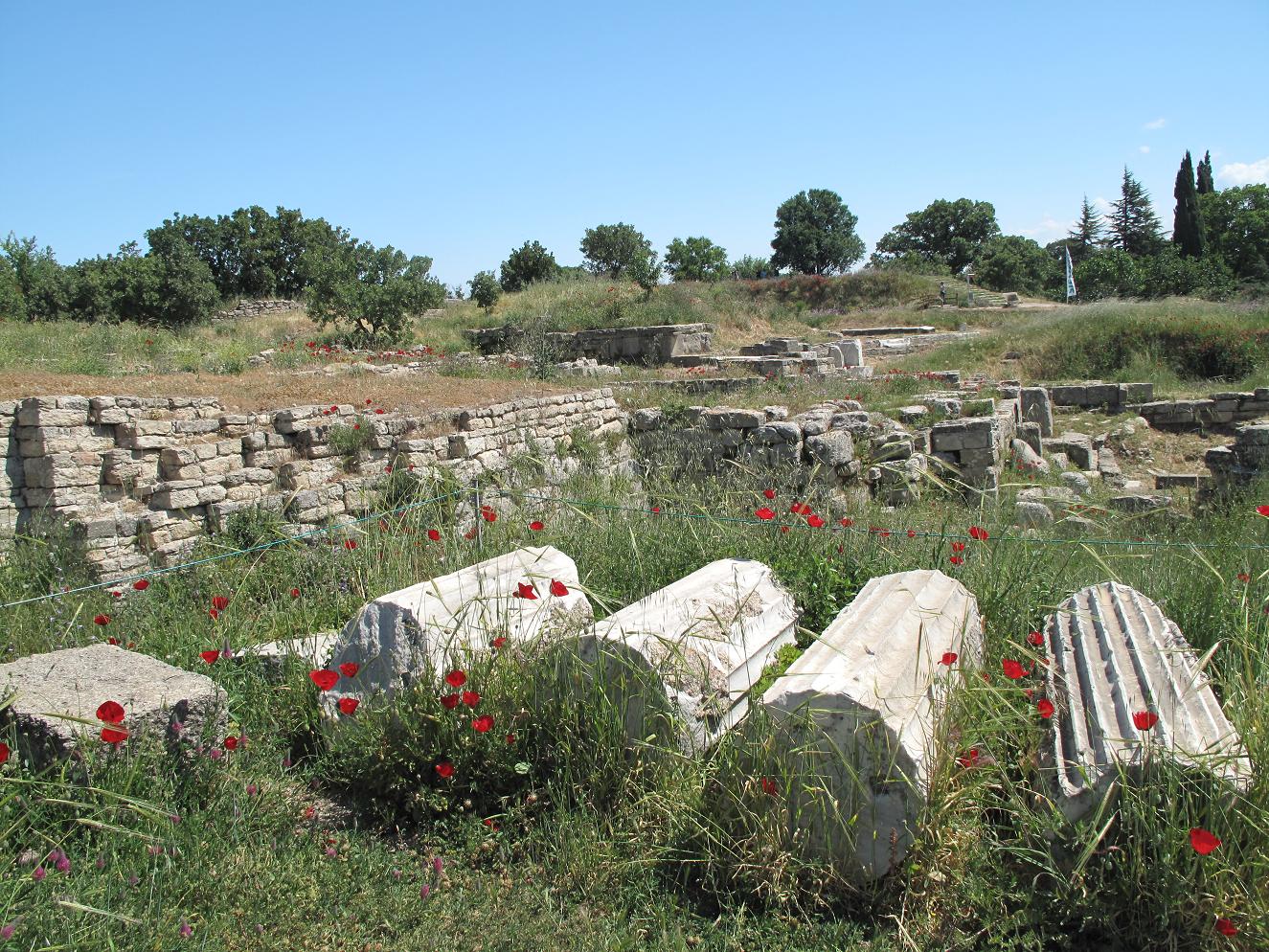
(Some of the typical ruins of Troy/Troia/Truva. I wish someone would just tell me what the real name was, as you see it all different ways.)

(These ruins could be anywhere from 1,500 to 5,000 years old. Amazingly, I didn't have my portable carbon dating kit with me, so I couldn't tell you.)

(One of the more elaborate ruins. That circle thing used to be used for doing circle stuff, and the diamond thing used to be used for doing diamond stuff...maybe a jeweler.)

(The small, mostly intact theater in the ancient city of Troy.)

(A few columns strewn among the grass and red poppies. This site was really scenic, not so much in the sense of extensive ruins, but just being a peaceful, pleasant grassy field amongst other pretty countryside.)

(I overheard one guide telling someone else that this piece on the right was an ancient roadway. Soon after, I was entertained by a turtle making his way noisily through the dry undergrowth.)


(That's me waving from inside the second level of the Trojan horse. This of course is a re-creation of the horse, as the Trojans probably didn't feel like keeping the original one around after causing the demise of their city. "Oh look, here's the joke that destroyed our culture. Haha. Those were good times.")


(Mmmmmm. Pide = Turkish version of pizza. This one had minced meat, cheese and some spices, topped with a chili sauce and served with a side of lettuce, lemons (for squeezing), parsley and onions, along with those red things you see on the top left plate (maybe a couscous mix thing). I don't really know what they were, but I ate them as lettuce wraps and no one seemed to give me any weird looks...or at least no more than normal.)

Wednesday, May 12, 2010

Hagia Sophia (Aya Sofya) and Topkapi Palace, Istanbul

Taking advantage of my prime location in the heart of Old Istanbul, I set out on foot to the nearby World Heritage Site - Hagia Sophia (Aya Sofya in Turkish). This incredible structure of domes and minarets overlooks a nice green courtyard and fountain, but the true beauty and history lie inside the gates and beyond the long line of tourists paying to get in. While waiting in line, trying to avoid carpet sellers, I was amused by the Russian man who first cut in front of me, and when I questioned him, he defended his actions, saying they had already been in line, but they had to go to an ATM and come back because the ticket agent only accepted Turkish Lira (imagine that - accepting Turkish currency in Turkey!). He then proceeded to mold the banana he was eating into a fairly accurate phallus, proudly showing his wife and friends. Moving on, we passed through a metal detector and entered into the massive building.

Originally built in 537 AD, Hagia Sofia has had quite a history, standing at the landmark of Constantinople/Istanbul for 1500 years. It was created under Roman rule, and it was eventually converted to a mosque when Mehmet the Conqueror took over the area and converted it to Islam. In addition to brilliant, peeling designs painted throughout the entire ceiling, tiled mosaics of Jesus, Mary and a few other notable religious figures adorn the marble walls.

As I entered, I was awed by the sheer size. Feeling like entering Grand Central Station in New York, crowds of people circled and wandered around me as I stared up at the ceiling three or four stories above me, held in place by a few massive pillars running all the way down to the marble floor. The open atrium served as the original place of worship, overlooked on each side by an open second level around the perimeter, looking down on the crowds below. Yet, in spite of all of the people, this was a place that truly makes you forget everyone around you. Looking at the intricate designs of the ceiling, partially peeled away, partially restored, flanked by a few massive circular plaques with Arabic script, the historical significance of the place was palpable. Wandering in and out of the hallways and columns, I eventually made my way up the winding stone stairway, looking like something straight out of a medieval castle. From the second level, the view was even more impressive, watching the people below scamper around in the unbelievably large atrium below. Eventually, I decided I must move on, but I couldn't help but take one or two final looks over my shoulder before leaving the building, amazed at the detail and scale of the entire place.

As if Aya Sofya weren't enough for one day, just a ten minute walk away from there is Topkapฤฑ Palace (in Turkish, the undotted letter i is pronounced like a "u/uh"). Walking through a large stone gate around the walled area/city, I entered into a beautiful grassy courtyard stretching for a few hundred yards, consisting of a few separate sidewalks, lined with rows of beautiful old trees, shading the way to the main entrance. The next gate and actual entrance point stood proudly with castle gates and turrets, almost like a fairytale. After paying the entrance fee, I was inside, trying to take stock of the many historical points around me. Divided into four courtyards, the palace reminded me of the Forbidden City in Beijing, as you pass from one courtyard to the next, completely separate from each other and blocked by huge stone walls, allowing only members of increasingly exclusive classes into the latter sections.

The palace was commissioned by Mehmet the Conqueror in 1453, and it has been home to rulers and sultans up until the mid 1800s. There are many unbelievable stories about those living inside, with my guidebook mentioning Selim the Sot who drowned after drinking too much champagne, Ibraham the Mad who was imprisoned by his brother for 22 years, then becoming insane, and Roxelana, a former concubine who became a powerful advisor to one of the sultans.

The first main attraction was a display of jewels and precious objects. The Treasury, as it's called, holds many unbelievable treasures, ranging from bejeweled, gold encrusted water canteens to the world's fifth-largest diamond. Moving on from the crowds of the treasury, I followed around to the back of the palace and into the fourth courtyard, revealing incredible views across the water to the Asian side of Istanbul and up around the Golden Horn, surely a stately backdrop for the sultans who would gaze upon this view of their city hundreds of years ago. Most impressive of all were some of the side rooms, such as one set of rooms for entertaining and relaxing in the back of the complex, covered from floor to ceiling in beautifully painted tiles, with just a few pillows/low couches for sitting and stained glass and open windows letting in the cool breezes rolling up to the top of the hillside palace.

I also didn't realize the historical significance of this place. With Constantinople being the center of the Middle East and Eastern Mediterranean for a long time, it had countless treasures brought in from countries far and wide, as well as being an important site for Muslims in the area. Within one exhibit, a whole array of religious artifacts were presented, including someone's cane, a plaster footprint from the Prophet Muhammad and even his tooth and pieces of his beard (I have no idea how they would have that). Though we often think of Israel as the Holy Land, I didn't realize how many stories and places in Biblical times involved Turkey.

On the way out, I also decided to visit the Harem, which required a separate entrance fee, but it was completely worth it. The fee kept a large amount of the other visitors out, and it revealed an incredible sub-section of the whole complex. Within this corner of the palace, there was a whole other community where the sultan's concubines mingled with each other, living together with the eunuch slaves (castrated men that were servants all around the palace). I walked through rooms with golden bathrooms and more unbelievably elaborate architecture, finally leading to a massive courtyard overlooking an ancient swimming pool below where the woman would relax with or without the sultan. Along the way, signs also pointed out a hallway where the sultan would pass, tossing gold coins along the ground when he was feeling particularly benevolent (or perhaps pleased with his harem of ladies - speaking of which, "harem" apparently just means "private" in Turkish).

Amazed by the palace, I left the castle-like setting and decided to rest a while in the shaded grass still inside the outer walls, getting ready for the soccer match that night. I had bought tickets the day before, and I was excited to go, though getting there wasn't as easy as I had hoped. The guy at my hostel told me how to take a bus there, but when I found where he told me to go, things didn't work out as planned. After trying to ask a lot of non-English speakers how to go, I ended up walking and walking, go for about 4 miles before finally getting back to a place I knew, where I decided that time was running short, and I'd try my luck with the subway. I took a combination of three subways, and I fortunately made it to the stadium with a half hour to spare.

As always, I was amazed at the passion and excitement for soccer games in foreign countries. Drums and songs filled the air, along with the smells of grilled kebabs and kofte, passing among the crowd of red and yellow jerseys, pushing forward to get into the arena. The security was tight with two separate checkpoints and a very narrow entranceway between a brick wall and iron fence, barely allowing one person at a time to pass through. Once in, I found a seat in the general admission (cheap) section and just enjoyed the atmosphere, listening to the songs, chants and dances that seemed to never end, spurred on by a few zealous fans leading the way, usually with their backs to the game, more concentrated on keeping the fans going than watching every moment of the game below. After a few missed chances, the game started out fairly slow, and I was afraid that a 0-0 tie may ensue, perpetuating boring soccer stereotypes to my loyal readers, but luckily that wasn't the case. The home team and probably most popular Turkish club team, Galatasaray, scored first, igniting a frenzy in the crowd. Then, just a minute later, the visitors tied it up on a fluke goal, igniting a hilarious celebration by the opposing goalkeeper, taunting the crowd that had been taunting him the whole game. Finally, with just a minute or two to play, the visitors added another goal, completely silencing the crowd who stood in shock until the final whistle. It really didn't matter to me, so I was quite content with my experience, and on the way back to the crowded subway, I couldn't resist the smell of the kofte, blackened beef patties grilled on a hot fire, stuffed into a small sandwich with some onions and parsley.

Though Istanbul had left quite a first impression on me, I knew I had to be moving on soon, as there was a lot left to see in this large, diverse country, so I'd be out on the road the next morning, though I wasn't 100% sure where I was headed, as is usually the case when I travel.


(The actual view of the Blue Mosque (Sultan Ahmet Camii) from my breakfast balcony. Amazing.)

(Inside Hagia Sophia, with its soaring ceilings and huge atrium.)

(The view from the second level looking down. This church/mosque has been around for over 1,500 years and is a deserving World Heritage Site.)


(A strategically placed window revealed a few of the domes of Aya Sofya in the foreground and my beloved Blue Mosque in the background. Obviously the Blue Mosque probably wasn't there when the window was first built.)

(One of the beautiful tiled mosaics lining the walls of the second level of Aya Sofya.)

(You always feel like somebody's watching you....Somewhat irreverantly, that song got stuck in my head after staring at this mosaic for a while.)

(Looking up at the detailed ceilings of the massive structure.)

(One of the huge discs with Arabic script was being restored on the other side of the building.)

(The beautiful green walkway from Aya Sofya to Topkapฤฑ Palace. I spent some time laying in the grass on the way out, as it was just too inviting not to stop and relax for a while.)

(The castle-like entrance to the palace. A bit crowded but definitely worth it.)

(Inside, I think this was the second courtyard. Either way, it was right outside the Treasury, where I saw huge diamonds, jewels and other ridiculously opulent artifacts.)

(Check out the incredible tile work and stained glass.)

(Crusing the streets of the Harem. I don't know if it's just me, but I didn't see any ladies.)

(This room was for the Sultan's entertainment, where he would sit on the altar and watch performances inside the Harem.)

(Again, another magnificent, hidden room in the Harem. I get the feeling the sultans spent a good bit of time in this place.)

(That probably says something in Arabic. I wouldn't know. Maybe we should ask the sultan.)

(Two windows overlooking the pool in the Harem.)

Istanbul aka Constantinople

After my night in the airport, I was hoping that my luck for the next flight would fare better. I found my Turkish-American friend in the airport, and she had apparently taken a bus downtown and stayed with a friend in Manhattan, so I don't know why she was so worried the day before. As the flight time drew near, I called my friend again, and things were looking pretty good, though without much room to spare, as the few remaining seats were filling up. I waited patiently (the same can't be said about my new friend), and finally my name was cleared, and I boarded the flight. Despite having to spend 31 straight hours in JFK airport (broken only by a quick donut break outside on the curb), my troubles soon faded away as I took my seat in business class. It's a strange transition from possibly not getting a seat on the plane to immediately getting one of the best ones, but I wasn't complaining. The seat was huge and comfortable, offering infinite legroom and personal tvs with a variety of movies and shows to choose from. The menu was quite extensive, with many different courses, drinks and desserts, most sounding nicer than places where I eat while home. Unfortunately, my new friend was just across the aisle from me, so I didn't get a lot of rest, as she likes to talk, but I did manage to enjoy two wonderful appetizers, steak, green beans, mashed potatoes, tiramisu and an elaborate ice cream sundae. Arriving in Istanbul after 10.5 hours, I have no sympathy for anyone who ever complains about a long flight in business class.

Not knowing more than two or three words of Turkish, I hoped things would be fairly easy in Istanbul, and getting on the first subway, things looked like they might work out pretty easily. I changed from the subway to an overground tramway and was soon marvelling at the sights around me. Entering into Old Istanbul, the architecture was a mix of classic European with Arabic touches, making a wonderful mix of sights as the train passed into the center of the old town. I got off in Sultanahmet, the center of it all, and I was immediately awed by the place. Walking to my hostel, I walked right in front of Hagia Sophia, a World Heritage site, an picturesque old church/mosque, fronted by a green courtyard and facing the Blue Mosque, which is actually a more impressive looking building than old Sophia herself. My hostel was literally three minutes down the hill from these incredible sights, and I couldn't be happier. As it turned out, I had missed the first night of the two night reservation at the hostel (while I was stuck in the airport), but they luckily still had a spot for me for the second night. I dropped off my bags and began exploring the city, since it was still only about 1 pm.

I began exploring the Blue Mosque, also known as Sultan Ahmet Camii, giving the area its name. Being Friday, the Muslim holy day, I walked up just in time to see thousands of worshipers lying prostrate on the floor in perfect lines, as one of their five daily prayers. After a few minutes, things cleared out a little, and I was able to have a look around the massive enclosed courtyard, surrounded by large stone walls on all sides, with an impressive skyline of staggered domes and two towering minarets jutting into the sky on each side. This is apparently the largest courtyard of any Ottoman style mosque, which makes sense as it's right in the heart of Istanbul. Amazingly, inside the mosque was almost more impressive than the wonderful exterior. The massive chamber inside opened up to huge domes and rotundas, decorated beautifully with intricate painted blue tiles covering the entire ceiling (giving it the Blue name). The place was built from 1606-1616, and it has been remarkably maintained with the exceptional stone and tile work.

Other than staring in awe at the Blue Mosque and Hagia Sophia, having trouble deciding which direction to look, my main task for the day was to head into the new part of the city and pick up tickets for a big soccer match the next day. Turkey, as with many European country, has a strong soccer tradition, and I had found that the country's biggest club team, Galatasaray, had a home match the next day, so I couldn't pass up the opportunity. On my way over, I was engaged in a conversation with a nice young guy who was impressed that I actually knew anything about Turkish soccer/football, though it eventually turned out that he was one of the ubiquitous carpet sellers that invite you back to their shop for tea and then to do some selling. I explained that I absolutely wasn't going to buy anything, but not to be rude, I eventually did check out his shop, though he and I only ended up talking about soccer, as I continually refused to hear anything about any of the rugs. We finally parted ways, and I headed back to the tramway.

I took the tramway down from Sultanahmet and was treated to more spectacular views. As a crossroads of Asia and Europe, Istanbul straddles a straight that connects the Mediterranean to the Black Sea, called the Bosphorus, separating the city into an Asian side and a European side. In addition, a small inlet further separates the city, sort of dividing it into three peninsulas all converging together. Besides the aquatic setting, it is also known as the city of seven hills, with each of these small hills being the location of another stupendous mosque with beautiful domed architecture and tall minarets pointing up into the sky like rockets. Passing along the coast on the tramway, I was treated to a great view of the ancient skyline, filled with historic buildings and broken up by the incomparable silhouettes of the mosques. Just across the water (known as the Golden Horn), I got off the tramway and onto a funicular/cable car that took me underground, up the large hill to Taksim Square, one of the centers of the new city.

Taksim Square was hectic and loud, yet it still managed to maintain some of Istanbul's colorful character. I took a stroll down Istikal Caddesi, the most popular pedestrian street in the city, filled with locals and tourists alike. Shops of all kinds tempted the eyes, but I personally couldn't resist the enchanting smell of the small kebab shops popping up every few hundred yards. Basically just a slow roasted meat sandwich with a few french fries sometimes stuffed inside, it's one of Turkey's national dishes, and I know it will be a staple of my trip here. The narrow restaurant had a hidden spiral stairway, leading to three stories of seating, allowing a perfect spot to enjoy my first Turkish kebab (kebap in Turkish), watching the hustle and bustle of the street below. After my meal, I wandered back down the street, stopping to watch a few street performers. While watching one group of musicians, I was a little paranoid about my belongings, as the crowd began to gather around, and then I heard a small noise just behind me that made me decide it was time to move on. Checking my backpack, nothing was missing or slashed, but I did find a nice large chunk of bird poop, and I looked up on the powerline above to see the culprit. Fortunately, it had hit my backpack and missed my head by just about two inches.

Moving on, I began to wander a few of the side streets, winding up in an area lined with store after store of music shops selling guitars, lutes and any variation of stringed instruments. I then found my way to Galata Tower, an imposing castle-like structure that can be seen anywhere along the waterfront, as it stands much taller than the surrounding shops. Winding down the side streets, I didn't exactly know where I was, but the waterways and hills always provide a good point of reference, and I was soon taking the long walk back to Sultanahmet. Along the way, I crossed the Galata Bridge, lined with local fishermen, smiling and telling stories, even offering to let me have a try at it, though I'm not a big fan of fishing, so I politely refused. Just as dusk was falling, I found my way back to the large grassy expanse situated between Hagia Sophia and the Blue Mosque and had a seat on the lawn, taking in the incredible surroundings of this impressive, historic city. The fountain was on, shooting water streams up, lit by alternating blue, red and green lights, perhaps taking a way just a slight bit of class of the area, though the stunning area has plenty to spare.

Back at my hostel, my small dorm room wasn't bad, but the view from the rooftop terrace was much better. Four stories high, the terrace had a nice view over Sultanahmet and a wonderful perspective of the Blue Mosque, lit with a slight gold tinge in the dark of the night. Adding to the end of a great day, local musicians played for the outdoor cafe guests below, providing an appropriate soundtrack for the panoramic views. My roommates turned out to be a talkative group of Koreans, so I didn't get all that much sleep, but even so, my bed was certainly better then the row of chairs at JFK, so I couldn't complain. Plus, I was just excited to get out and explore more of the city the next day.


(Inside the huge courtyard of the Blue Mosque - truly an amazing site.)

(Literally across the street from the Blue Mosque sits Hagia Sophia, almost a thousand years older.)

(Of course my first meal in Turkey had to be a kebab, stuffed with beef and a few french fries in a sort of pita wrap.)

(Heading down one of the most popular streets in Istanbul, Istikal Caddesi, in the area of Taksim. While watching a local band play for donations, I narrowly averted a well-aimed drop of bird poop. My backpack wasn't so lucky.)

(Massive Galata Tower can be seen from many places around Istanbul.)

(The view of the Blue Mosque just moments after stepping off of the tramway at the Sultanahmet stop on the way to my hostel.)

(The tiled walls and ceiling of the Blue Mosque are incredibly detailed and beautiful.)

(The massive ceilings are completely covered in the blue tiles, giving the mosque its popular nickname.)

(Yes, I like this place - both the mosque and Istanbul itself.)

(Looking out at the Blue Mosque with Hagia Sophia directly behind me as I took this picture. See the next shot to see the view behind me.)

(Hagia Sophia, built around 600 AD, standing proudly over a fountain and garden.)

(At dusk, the courtyard of the Blue Mosque had cleared out, and the area was much more peaceful after both the worshippers and tour groups had cleared out.)

(Ending my first night in incredible Istanbul, I couldn't help but take one more picture of Sultan Ahmet Camii/the Blue Mosque.)

Thursday, May 6, 2010

Off to Istanbul, Turkey - Sort Of

Recently a good friend of mine got a job at Delta, and I was lucky enough to be offered one of his buddy passes for my trip to Turkey. That means that I only had to pay about half of the price of a normal ticket, and there's a chance that I'd get upgraded to business class which would be quite a perk on a 10.5 hour flight. The downside is that you have to fly standby, and with him only working at Delta for a year or two, I'd be pretty low on the list. Looking at the schedules and standby lists, we decided that the Monday and Tuesday flights both looked pretty full and risky, so we opted for a Wednesday departure. As it turns out, both Monday and Tuesday would have been great, as there were plenty of seats in business class available. Even so, I was still hopeful for Wednesday.

I started with an early morning flight up to New York City (JFK), and I didn't really know what to expect. It turned out to be very easy, as there were nearly 60 empty seats, so I was never in doubt. I got up to JFK at 9:30, meaning I had 7 hours to wait until my potential flight to Istanbul. As I meandered back and forth, up and down the hallways of the terminal, I chatted with a few Delta agents, and my chances of getting on the plane looked pretty good. Then, little by little, people kept checking in, and a few more standby passengers came, placed ahead of me based on their friends' tenure at Delta. As the time drew closer, our names were put up on the board, mine being number 4, still showing that 5 business class seats were available. Then the agonizing part began as my name fell to five, six and then seven. The only chance was then that someone who had checked in would not make the flight, which seemed unlikely to me. All the while, a small, older Turkish-American woman also flying on a buddy pass was chatting away, trying to argue with the gate agent that her name was on the list and thus should put her on the flight. (Sadly, her nephew had not even mentioned the very real possibility of not making the flight.) Frustrated with the agents, she began sharing her complaints with me, as I tried and tried again to calmly explain to her the process (which I just slightly understand). I was able to find one very helpful worker at the gate who answered my questions about where my baggage would be, what to do, etc. Although I thought all hope was lost, he kept saying that a few people were still missing, so we clung to that small shred of hope. The woman waiting with me also informed me that, "between you and me, if there's a spot on the flight, I get it, ok?" How nice of her.

At 4:19, just as the flight was supposed to be backing out of the gate, a family of four came running up, out of breath, claiming four of the final six seats on the plane. That would leave two seats for me and my new-found Turkish "friend," but our hopes were dashed just moments later as a pregnant Turkish woman in a headscarf and her husband came running around the corner, just before the gates were to close. So, that was it. We didn't make the flight. At this point, the older Turkish-American woman was becoming really concerned as she came up from Virginia and didn't know where she could stay and also noted that her two pieces of luggage would be way too heavy to move around again. Fortunately, the gate agent informed us that we could simply leave our baggage downstairs (it doesn't go on the flight unless we do), and we could just stop by tomorrow and tell them to put it on that flight (assuming we can get on). As I was pondering what I'd do, and if I needed to help this woman into town, the agent gave her pretty clear directions on how to get into town and find an area with some hotels, so she was in better shape. I contemplated leaving, but I decided I didn't want to deal with the hassle and cost of getting away from the airport, getting a hotel somewhere and then having to get back, so I just decided that I'd try my luck in the airport.

I also had suspended my cell phone in the morning, so I had to rely on a few overpriced pay phone calls to get in touch with Marcelle and my friend at Delta. Though Wednesday had looked promising, things just didn't turn out as planned, and we both contemplated my options. I could try again on Thursday, which also looked good, or I could also consider another destination. If Istanbul's flight was full again, I thought about possibly going over to Athens, Greece, Amman, Jordan or Cairo, Egypt, though I have no idea what I'd do when I got to any of those places. We scheduled a call on the pay phone for 2:30 the next afternoon where I'd get an update on the flights and try to make some decisions, and we were both amazed that you actually can still just call back the number on a pay phone, and it will ring at that phone.

Getting late into the evening, I had walked up and down the hallways many times, literally scouting out any potential place to spend the night. I was very tempted by two American Red Cross cots that I saw lying next to one of the gates, but I figured those were for emergencies, and I might get in trouble if I tried to use them. The next best option was literally the only row of seats in the entire terminal that did not have armrests preventing you from laying length-wise across them. Even better, this row was hidden in a little nook in the corner of a secluded gate, providing a quiet place for the evening. Remembering back to a few years ago when I slept in the Tahiti airport where the traveller sleeping 10 feet away from me had all of his money, baggage and even shoes stolen, I made sure I felt secure in my spot. I locked up my small backpack (my big one was still downstairs in baggage), and I was able to wrap it up on the back of the row of chairs, wedging it all up against the wall, so it would be literally impossible to get to it without moving me out of the way first.

As I was getting ready for bed, I saw that there was one other man that seemed to be planning on sleeping nearby. He was a small, Hispanic man on crutches, with only one leg (the other was an empty pant leg tied off above the knee). We exchanged glances, but that was the extent of our interaction. Then, minutes later, an agent appeared and dropped off three small blankets and two pillows (the airplane type) for him. I was about to ask the agent if I could also get those, but he was out of there before I had a chance. It wouldn't matter, though. I had decided that the semi-padded chairs and my book as a pillow would be good enough, as I was already really exhausted from the long day. Then, as I was drifting off to sleep around 10 pm, I heard the sound of the creaking crutches coming over. I looked up and saw the old man standing above me. He didn't say a word (he spoke little or no English), but he just smiled and handed me one of his blankets and pillows. I thanked him, and he was quickly back to his corner as I once again marvelled at the kindness of strangers in the most random moments all over the world.

My sleep was not great, awaking every hour or so to rotate between my left side, my back and my right side with the upturned seat edges jutting into my back and leg, but it was probably better than expected. I woke up around 6 am, as passengers filled the gate on their way to board a flight to Atlanta. Being hidden in the corner, laying on my makeshift bed and blocked by another row of seats pulled over in the corner that shielded most people from seeing me, I heard a few interesting conversations, first a cell phone call of a passenger making sure his friend brought the weed for the vacation, then a long back and forth about the sexcapades of two airport workers.

I again walked up and down the airport, talking with some workers, having a small breakfast and then deciding I should ensure that my baggage would get on the flight with me today. I went downstairs and was taken into a dirty backroom with some luggage, instructed to find mine. After double-checking, we confirmed that my bag actually wasn't in there. Back in the main room, we checked again and found that my bag is already in Istanbul (which it shouldn't be), so I'll have to pick it up when I arrive. The problem is that this obviously limits my possibilities of changing destinations, as my bag would probably have to be shipped back to New York and then out to the next destination, a day or two behind me.

So, as I sit here now, knowing the layout of JFK's Terminal 2 like the back of my hand, I'm hopeful that I'll get on the flight today, though I've already been getting mixed messages from some of the workers about my potential status for the flight. I'll have a better idea after my 2:30 call today, at which point I may have to make some big decisions. Who knows - maybe I'll be in Istanbul tomorrow...maybe Amman...maybe Athens...maybe back in Atlanta.

Travel is always an adventure.

Monday, October 12, 2009

A Quick Stroll Through Kyoto

 (Fushimi-Inari-Taisha - amazing temple site South of Kyoto with 4 km of walkways lined with orange/red archways.  This was one of my favorite spots, wandering the trails of torii.)

 (Another random, inspiring temple...one of hundreds in the city.  Our hotel sat next to two large temples, though that can probably be said of most hotels in the city.)

 (Tenryu-ji - scenic temple, gardens and Arashiyama bamboo forest nearby.  Approx 1 hr 20 minute bus ride from Kyoto train station, but the bamboo forest is certainly worth it.)

 (Ryoan-ji - Famous rock garden.  Good for tranquility, not so good for greenery.)

 (Kinkaku-ji - Golden Temple - one of the most popular temples in a beautiful setting, but be prepared to push some people around to get this picture as there are usually big crowds here....still worth it, though.)

 (Ginkaku-ji - Silver Temple.  Nice garden in the back, manicured rock garden and scenic temple.  Well worth a visit...sadly, you can't walk across that little stone bridge.)

 (A higher view of the Silver Temple from the top of the adjacent garden, looking back down towards Kyoto.)

 (I believe this is Chion-in?  There were so many beautiful temples that I may have lost count, each one well-manicured and elegant.  Not quite like me, especially when backpacking around a country.)

 (Looks like another amazing temple...)

 (Kodai-ji - lit up at night for an amazing display.)

 (Lit bamboo forest in Kodai-ji.)

(Arashiyama Bamboo Forest...not always this empty, but an amazing spot...this path leads up about half a mile lined with thick bamboo.  This could possibly be the road to enlightenment...you'll have to go visit to find out.)

Copyright © Derek's Travels | Published By Blogger Templates20

Design by Anders Noren | Theme by NewBloggerThemes.com